BGE’s BWI Chargers Keep Failing – When Is Enough, Enough?

BGE BWI Airport EV Chargers

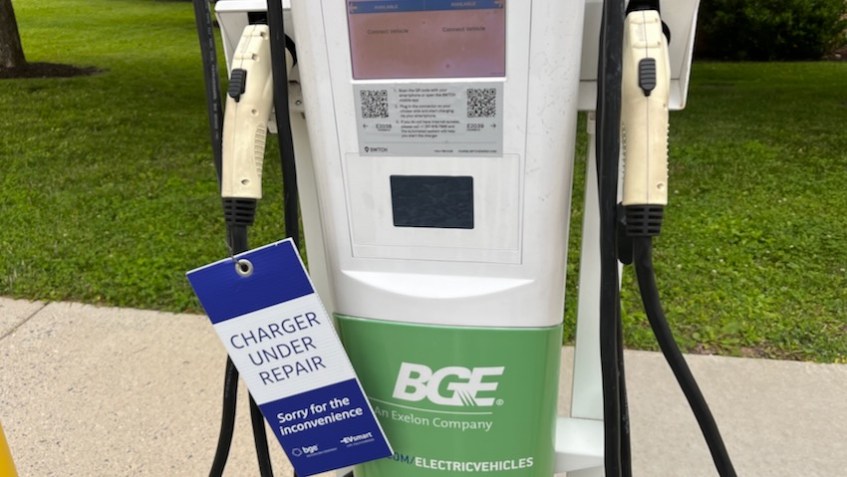
On June 5, 2026, I filed the following letter with the Maryland Public Service Commission documenting the latest in a series of reliability failures at the BGE-owned DC fast chargers at BWI Airport, including a reported network disruption that left all ten chargers offline on June 4.

Re: Case No. 9478 – Recurring Reliability Failures at BWI Airport BGE Fast Chargers and Reported SWTCH Network Disruption

Dear Mr. Johnston,

I am filing this update regarding the ongoing reliability failures with BGE-owned DC fast chargers at BWI Airport and a reported SWTCH network disruption that, according to a customer service representative, affected a large sector of the network on June 4.

Background

This is not my first filing on this matter. On July 31, 2025 (ML 320870), I reported a safety hazard and numerous non-operational chargers at BWI to the Commission. On October 27, 2025 (ML 323675), I reported a SWTCH network outage that, according to a customer service representative I spoke with at the time, affected approximately 4,000 chargers across the network. On January 29, 2026 (ML 326644), I reported that 9 of 10 fast chargers at the two BWI sites were out of service during a period of extreme cold when we particularly need public charging.

BGE’s March 12, 2026 response, relayed through the Commission, reported that all Cell Phone Lot stations had been repaired by February 3 and that the Rideshare Lot stations had been repaired that same week, with the exception of station E1188/E1189, which required a power module rebuild. Parts had been received but repairs had been delayed by weather conditions. BGE reported that as of March 12, the Rideshare Lot had 4 of 6 stations operational and the Cell Phone Lot had 3 of 4 online, with two additional stations, E1190 at the Rideshare Lot and E1038/E1039 at the Cell Phone Lot, placed back under repair in early March due to unsuccessful charging sessions.

I also note that the BWI chargers are located on MDOT property and that reliability concerns at these sites were raised at the May 20, 2026 ZEEVIC meeting by ZEEVIC member Paul Verchinski, who noted that four of the ten chargers were offline or under repair as of that date. By May 28, 2026, seven of the ten chargers across both sites were under repair. On May 28, 2026, I recorded a video at the BWI Cell Phone Lot documenting that all four units had blank screens and were non-functional. That video is available at https://youtu.be/ZqutUXlZyN8 and is submitted as part of the record of this ongoing pattern of failures.

Current Status

As of approximately 1:30 PM on June 4, 2026, all ten BGE-owned fast chargers at BWI Airport were reported as under repair or offline. This includes all six at the Rideshare Staging Lot and all four at the Cell Phone Lot. Screenshots from the SWTCH app documenting the status of all ten chargers are attached as Exhibit A.

I called SWTCH customer support to confirm the status. A representative indicated that a large sector of the SWTCH network was down. I was unable to independently confirm the full scope of the disruption or whether RFID cards remained functional at affected stations.

The Pattern

BGE’s March 2026 response reported that the chargers affected by the January outage had been repaired, yet by early March two stations had already been placed back under repair due to unsuccessful charging sessions. On June 4, all ten chargers were offline again, this time coinciding with a reported SWTCH network disruption. This is not an isolated incident. The record in this docket documents repeated, substantial reliability failures at the BWI sites going back to at least July 2025.

BWI Airport is one of the most heavily utilized charging sites in the BGE network, serving rideshare drivers, airport patrons, and the general public. These drivers cannot easily divert to alternative locations, particularly rideshare drivers whose apps use geofencing that removes them from the passenger queue if they leave the lot to charge elsewhere.

I respectfully request that the Commission ask BGE to provide:

  • An updated status report on both BWI sites including station E1188/E1189, which BGE indicated in March required parts that had already been procured and was pending suitable weather for repair.
  • A root cause explanation for the June 4 outage, including whether it is attributable to the reported SWTCH network disruption, and what steps BGE and SWTCH are taking to prevent or mitigate the impact of future network disruptions. This is the second reported network-level disruption affecting utility-owned charging infrastructure that I am aware of, the first having been cited in my October 27, 2025 filing (ML 323675).
  • An explanation of what process BGE has in place to restore entire sites that go offline due to causes such as circuit breaker interruptions, and what the expected timeline is for restoring service when a physical site visit is required.

The Commission has been monitoring BGE’s quarterly reliability reports and received BGE’s assurances of improvement. Recent events including the May 28 and June 4 situations suggest those assurances have not translated into durable reliability at the BWI Airport sites.

Sincerely,

Lanny Hartmann

BWI Airport Fast Chargers Offline During Extreme Cold

Temperatures at BWI Airport dropped to around 10°F this morning as an Arctic air outbreak continues across Maryland. Cold weather reduces EV range and increases demand for fast charging, making reliable public stations especially important for airport users and rideshare drivers.

The four 150 kW DC fast chargers in the BWI Cell Phone Lot, operated by Baltimore Gas and Electric (BGE) through its EVsmart program on the SWTCH network, are currently listed as “UNDER REPAIR” in the SWTCH app.

These chargers were unveiled on May 24, 2021, as part of Maryland’s push to expand EV infrastructure. BGE later installed additional units in the nearby Rideshare Staging Lot, bringing the total to ten fast-charging ports across the two sites (four in the Cell Phone Lot and six in the Rideshare Staging Lot).

At the Rideshare Staging Lot, the SWTCH app shows that only one CCS connector is operational, with the rest flagged as “UNDER REPAIR” or “UNAVAILABLE.” Across both locations, nine of the ten ports appear out of service at this time. Some units have been unavailable for more than a week, with at least one offline for months based on ongoing user reports.

Read More …

Howard County Council Approves EV Chargers at Library Despite Reliability Concerns

EV charger under repair at the Miller Branch of the Howard County Library
EV charger under repair at the Howard County Library, Miller Branch

On November 3, 2025 the Howard County Council voted to grant a 3,600 square foot easement on County property to allow BGE to install an EV charging station at the Elkridge Library. The resolution, CR169-2025, had been tabled from the October legislative session. Council Chair Liz Walsh expressed concern about the general lack of parking at the library and the prospect of reserving some of the existing parking spaces for EV charging.

Proposed Amendment to Ensure Reliability

When the tabled resolution came up for a vote on Monday, Walsh moved to add an amendment to impose maintenance and functionality requirements for the BGE-owned charging station as a condition of the easement. The amendment, proposed by Walsh, stated, “BG&E shall maintain uptime standards for each new EV charging station installed at the Elkridge Library, in accordance with Section 7-904 of the Public Utilities Article of the Annotated Code of Maryland.” The cited statute is Maryland’s Electric Vehicle Charging Reliability Act (HB 834) which was signed into law in 2023 and requires 97% uptime in accordance with NEVI for the state’s utility-owned EV charging stations. The amendment further stated that failure to maintain uptime to standards would result in a civil penalty from the County of up to $1,000 for each violation.

Charger Reliability Concerns

Those of you who have EV charging stations in your own districts may notice that they don’t seem to be consistently working, and so this was our effort to ensure that in exchange for a loss of parking available to everyone, we actually had charging stations that worked. -Liz Walsh, Chair

The concerns that lead to the amendment are well-founded. Many BGE-owned EV charging stations on Howard County properties have had a poor track record for reliability. According to BGE’s own data submitted to the Public Service Commission, more than half (31 of the 58) BGE charging plugs located in Howard County failed to achieve 97% average uptime during the 3rd Quarter of 2025. Four BGE fast charger plugs located at the old County Courthouse never worked at all during the period from July 1 to September 30, 2025.

Read More …

First Meeting of Maryland Electric Vehicle Supply Equipment Workgroup

Hagerstown Maryland EV Chargers

Effective July 1, 2024, the Maryland General Assembly authorized the Electric Vehicle Supply Equipment (EVSE) Workgroup. The Workgroup is tasked with developing a framework for reliability and reporting standards for electric vehicle charging stations, studying and making recommendations regarding which government entities have responsibility for ensuring accountability for charging stations, and making recommendations on adopting and implementing regulations.

The EVSE Workgroup held its inaugural meeting on Tuesday, July 9, 2024. Chaired by the Maryland Public Service Commission, the Workgroup consists of 13 members designated by the authorizing legislation. Members of the public were given an opportunity to provide comments at the end of the meeting. A recording of the meeting is now available on the Commission’s YouTube channel.

Senator Shelly Hettleman, the sponsor of Senate Bill 951 that created the EVSE Workgroup, said the idea stemmed from hearing her constituents’ frustrations. Both current electric vehicle owners and potential buyers have voiced concerns about the existing infrastructure. As she investigated further, it became clear that many different agencies have oversight responsibilities, but there is a lack of seamless coordination among them. A key area needing improvement is ensuring that charging stations are up and running and being as efficient as possible.

Read More …

New Jersey Enacts EV Charging Uptime Legislation

EV Charging Reliability

New Jersey Bill S3102

Approved by the Governor: 1/16/2024.

New Jersey bill S3102 Establishes uptime requirement for electric vehicle charging station incentive programs.

This statute directs the Board of Public Utilities (BPU) to establish a requirement, as a condition of providing any incentive for the installation of electric vehicle service equipment pursuant to P.L.2019, c.362 (C.48:25-1 et seq.) or any other State law, that the station is operational at least 97 percent of the time, as measured on an annual basis. The law also directs the BPU to develop and implement a process to establish, monitor compliance with, and enforce this requirement. As used in the law, “electric vehicle service equipment” means the equipment, including the cables, cords, conductors, connectors, couplers, enclosures, attachment plugs, power outlets, switches and controls, network interfaces, and point of sale equipment and associated apparatus designed and used for the purpose of transferring energy from the electric supply system to a plug-in electric vehicle.

Read More …

Call for Enhanced Oversight and Accountability of Electrify America’s Charging Infrastructure

Electrify America Unavailable

Comments to California Air Resources Board (CARB)

The California Air Resources Board (CARB) will hold a public meeting to consider a staff assessment of Electrify America’s Cycle 4 Zero Emission Vehicle Investment Plan on January 25, 2024. The Board will then decide whether to approve or disapprove the plan.

I submitted the following comments to the California Air Resources Board:

To: cotb@arb.ca.gov
January 23, 2024

Re: 24-1-2: Electrify America’s Proposed Cycle 4 Zero Emission Vehicle Investment Plan

Dear California Air Resources Board,

I am writing as a concerned advocate for electric vehicle drivers. Last summer I travelled through the state of California in an electric vehicle. I encountered many of my fellow EV drivers who were having issues with non-functional Electrify America charging stations. Harris Ranch had a line of frustrated EV drivers waiting to use it because most of the six dispensers were down.

The reliability issues surrounding Electrify America’s charging infrastructure have raised significant concerns within the EV community. While the initial intent of the company to address the fallout from the 2015 Dieselgate scandal was commendable, it appears that their efforts have fallen short, leading to a new crisis in the form of unreliable charging stations.

The recent Sacramento Bee article by Ari Plachta highlighting the reliability challenges faced by Electrify America underscores the urgency of addressing these issues. As an active participant in promoting EV adoption, I find it disheartening that a company established with the explicit purpose of rectifying past wrongs is now contributing to hindrances in the widespread adoption of electric vehicles.

The reliability issues reported, including broken screens, faulty payment systems, and slow charging, are significantly impacting the EV user experience. This not only undermines the trust of current EV drivers but also dissuades potential buyers from making the switch.

Electrify America ranking last in consumer satisfaction, as reported by J.D. Power, is indicative of the severity of the problem. The satisfaction score of 538 out of 1,000 is alarming, especially when compared to Tesla’s score of 739.

Unreliable charging infrastructure poses a major hurdle to achieving widespread EV adoption. Reports suggest that approximately 18% of individuals who switch to electric vehicles end up returning to gas-powered cars due to charging inconveniences. Given the magnitude of the issue, I urge the California Air Resources Board to consider the following actions:

1. Enhanced Oversight: Strengthen oversight mechanisms for Electrify America, ensuring that the company adheres to higher standards of performance and reliability. Confidence in California’s public charging network is crucial for the success of EV adoption.

Read More …

Broken Charging Stations Threaten Maryland’s Electric Vehicle Goals

Broken Charging Station

300,000 Electric Vehicles by 2030

Maryland aims to have 300,000 electric vehicles on the road by 2025. As of December 31, 2022, there were 62,744 EVs registered in the state. As the number of EVs in Maryland continues to grow, it is essential that the state’s EV charging infrastructure keeps pace.

One crucial aspect of growing the infrastructure is ensuring that the EV charging stations are fully functional. When they are out of service or malfunctioning, it can create a major inconvenience for EV drivers, especially during longer trips. People who live in apartments and cannot charge at home also depend on public charging to get to work and for other essential travel. Equitable distribution of EV charging is necessary, and the reliability of those charging stations must be ensured as well.

Utility-Owned EV Charging Stations

Maryland is one of the few states that allows regulated utilities to own and operate public EV charging stations, and pass the cost on to the rate base. The Maryland Public Service Commission approved a pilot program that permits over 1,000 charging ports to be run by utilities, including BGE, Pepco, Delmarva Power, Potomac Edison and SMECO. The cost of the program will be passed on to ratepayers, regardless of whether they drive an EV or not. Currently, the stations are losing money, but it is hoped that increased usage will eventually make them self-sustaining financially.

Facing Challenges

Four years into the pilot program, utility-owned charging stations are facing challenges. Despite assurances to maintain high reliability, the results have been disappointing. In a customer satisfaction survey conducted by BGE and published in their semi-annual EV pilot program report, 26% of respondents reported not being able to complete a charging session, and 27% reported broken equipment. Negative reviews on the crowdsourced EV charging app PlugShare have also led to low utilization.

Reliability Standards

When the Public Service Commission was considering the utilities’ EV charging pilot programs, the Commissioners were assured that the public charging network would be maintained to a high degree of reliability. However, there is currently no regulatory standard for charging station reliability metrics, as there is for the grid, which has standards like SAIFI, SAIDI, and CAIDI.

In September 2022, I visited all 69 BGE fast chargers in Maryland and checked how well they were functioning. The results indicated that 29% of the chargers had some kind of deficiency, ranging from complete failure to reduced power output. During a follow-up round of testing two months later, the number of malfunctioning chargers had increased from 29% to 35% of the total. These findings suggest that the reliability of the utility’s public EV charging stations is not meeting the expectations that were set when the pilot program was approved.

Accountability to Ratepayers

These results are not only concerning for EV drivers but also raise questions about accountability to ratepayers. We should be able to trust that the utilities are maintaining their charging stations to a high degree of reliability, as promised. As ratepayers, we deserve to know where our money is going and how effectively it’s being used.

To address these issues, Delegates David Fraser-Hidalgo and Jen Terrasa are sponsoring the Electric Vehicle Charging Reliability Act (HB 834), which sets a minimum uptime standard and requires regular reporting on the performance and cost of utility-owned charging stations. This will provide transparency for EV drivers and ratepayers and help the utilities quickly identify and resolve any issues.

Focus on the Driver Experience

Maintaining reliability is an important step towards ensuring that Maryland’s charging infrastructure is robust. By keeping focus on good EV driver experience and reliable charging infrastructure deployment, Maryland will maintain its position as a leader in EV adoption. The state’s goal of 300,000 electric vehicles on the road by 2025 will only be achievable when the public can charge quickly, affordably and most of all, reliably.

Charger Reliability Transparency

reliability report

The following letter of comment on proposed EV Charger Reliability Standards was filed with the Maryland Public Service Commission on December 12, 2022 (ML 300467)

Re: Case No. 9478 – Public Conference 44 Electric Vehicle Work Group Supplemental Reliability Summary Report

As a BGE ratepayer and EV driver, I respectfully request that the Commission require the EV Pilot Utilities to provide a detailed explanation each time that one of their public charging stations experiences a no-charge event, consumer complaint, or system alert.

The Electric Vehicle Work Group has twice delayed establishing reliability reporting standards for the EV Pilot Utilities. We should not have to wait for federal guidelines for the National Electric Vehicle Infrastructure (NEVI) program to be released. We can begin collecting thorough data on each malfunctioning charger immediately without waiting for those guidelines.

Background

The reliability of public EV charging stations is crucial for providing a positive experience for EV drivers. As ratepayers, we deserve accountability for the money used to build the utilities’ public charging stations. When the Commission was considering the EV charging pilot programs, BGE assured us that they would maintain public charging stations to a high degree of reliability.

We have a regulatory obligation to maintain the charging networks much like any other distribution asset that we have. This is going to avoid situations where you have prolonged EV charger outages due to a breakdown or subsequent vandalism or any sort of things that could befall one of these chargers, and it is our goal of course as always to provide excellent customer experience for those EV chargers.

Sept. 6, 2018 Hearing Video at 2:34:38

Network Vendor Statistics

Based on the Shell Recharge Solutions Sky network dashboard, BGE reported 95% uptime (99% if “unknown” is counted) in the most recent semi-annual report. The PHI Utilities reported an aggregate uptime of 99.7% and SMECO reported an “overall uptime of over 98%.”

Potomac Edison uses the ChargePoint network and provides quarterly uptime for each charging station. They also give details on the steps taken to repair each outage. For example:

On February 21, 2022, PE notified drivers that the charging station located on the right, at the Friendsville Veterans Memorial Park, was out of service. PE and ChargePoint actively worked on resolving the issues across three site visits with technicians on February 15, 2022, March 4, 2022, and March 11, 2022 (descriptions above). The site was partially operational on February 15, 2022, (meaning 1 of 2 DCFC was operational) and fully operational on March 11, 2022, (meaning 2 of 2 DCFC was operational). PE posted outage notifications on PlugShare and the ChargePoint applications notifying customers of the extended outage at the Friendsville Veterans Memorial Park.

Potomac Edison Semi-Annual Report – August 1, 2022, ML 241711, page 14
Read More …

Sabotage

Sabotage

Oh my god, it’s a mirage.
I’m tellin’ y’all, it’s sabotage.
– Beastie Boys

Politicians never miss an opportunity to remind us of what they’re doing “for the people.”

One such missive came this week from the Office of House Majority Leader Steny Hoyer. A press release marked the one year anniversary of the $1.2 trillion Bipartisan Infrastructure Law (BIL).

The BIL includes $7.5 billion of funding for a National Electric Vehicle Infrastructure (NEVI) plan. Companies are lining up to get a piece of the EV charging infrastructure pie.

The Congressional press release happened to quote my recent remarks to the Washington Post to illustrate “how the Bipartisan Infrastructure Law is delivering results For The People in all fifty states.”

Bipartisan Infrastructure BIL

“Drivers of electric vehicles that use a different plug [than Tesla] need a network of chargers that are convenient and reliable. That’s what is exciting about the national electric vehicle infrastructure plan.”

Lanny Hartmann

The key word here is, “reliable.” Drivers of electric vehicles (The People) need chargers that are solidly reliable.

Do the politicians, government officials, and company executives who cut the ribbons to inaugurate new charging stations understand that The People often suffer once the cameras go away?

Read More …

Charging Failed – BWI Cell Phone Lot EV Chargers

After the Ribbon Cutting

The EV chargers at the BWI Airport Cell Phone Lot are an impressive backdrop for a photo opportunity. The towering units adorned with BGE logos looked appropriately stylish and high-tech the morning of May 24, 2021. Dignitaries clutched gigantic scissors and on “3, 2, 1,” snip, the ribbon fluttered to the ground. Such was the celebratory atmosphere less than a year and a half ago.

This is another example of our work to make Maryland a national leader in electric vehicle infrastructure.

Maryland Secretary of Transportation Greg Slater – May 24, 2021 press release

I’ve been here for 20 min and still haven’t been able to even start charging.

Nissan LEAF driver at BWI Cell Phone Lot – Sept 18, 2022 (PlugShare)

30,000-Foot View / Three-Foot View

The speeches at EV charger ribbon cuttings predictably weave tales of a bright vision for electric vehicles and electric vehicle charging infrastructure.

Expanding access to electric vehicles and infrastructure is a major step toward ensuring a cleaner and brighter future for our community.

BGE CEO, Carim Khouzami – May 24, 2021 press release

The 30,000-foot view from the lectern soon gives way to the “three-foot view” of an EV driver. Three feet is about the distance that we stand from a charging station as we poke at screens and wave cards attempting to charge.

The three-foot view is the perspective of the hopeful EV driver. It’s what remains long after the shards of ribbon have been whisked away. There are no cameras to capture the event for the six o’clock news. Just a low battery and an EV driver anticipating the flow of electrons.

The 30,000-foot view is fuzzy on details. The three-foot view can be brutally sharp.

4 DC Fast chargers here. 1 down for maintenance, the other 3 have a “tower” error.

BMW i3 driver – Feb 1, 2022 (PlugShare)
BWI Cell Phone

Error Code

In my test of BGE chargers in August, one of the four chargers at BWI Cell Phone Lot did not function as expected. When I returned 11 days later for a follow up evaluation, that unit still did not function. Thirty days after the first test, the charger was working. But by that time, two different machines wouldn’t start.

Read More …